![反応制御学研究室[大野研究室 / Ohno LAB.]](https://www.ironmaking.kyushu-u.ac.jp/wp/wp-content/uploads/2025/04/スクリーンショット-2025-04-07-16.54.15.png)
QFC-SP高等学校研究インターンシップの研究活動が進んでいます。
本テーマは、「マイクロ波加熱を用いた電気炉(EAF)ダスト中の亜鉛処理」に関する基礎研究です。将来的な資源循環や製鉄プロセスの脱炭素化を見据え、まずは現象を正しく理解することを目的としています。
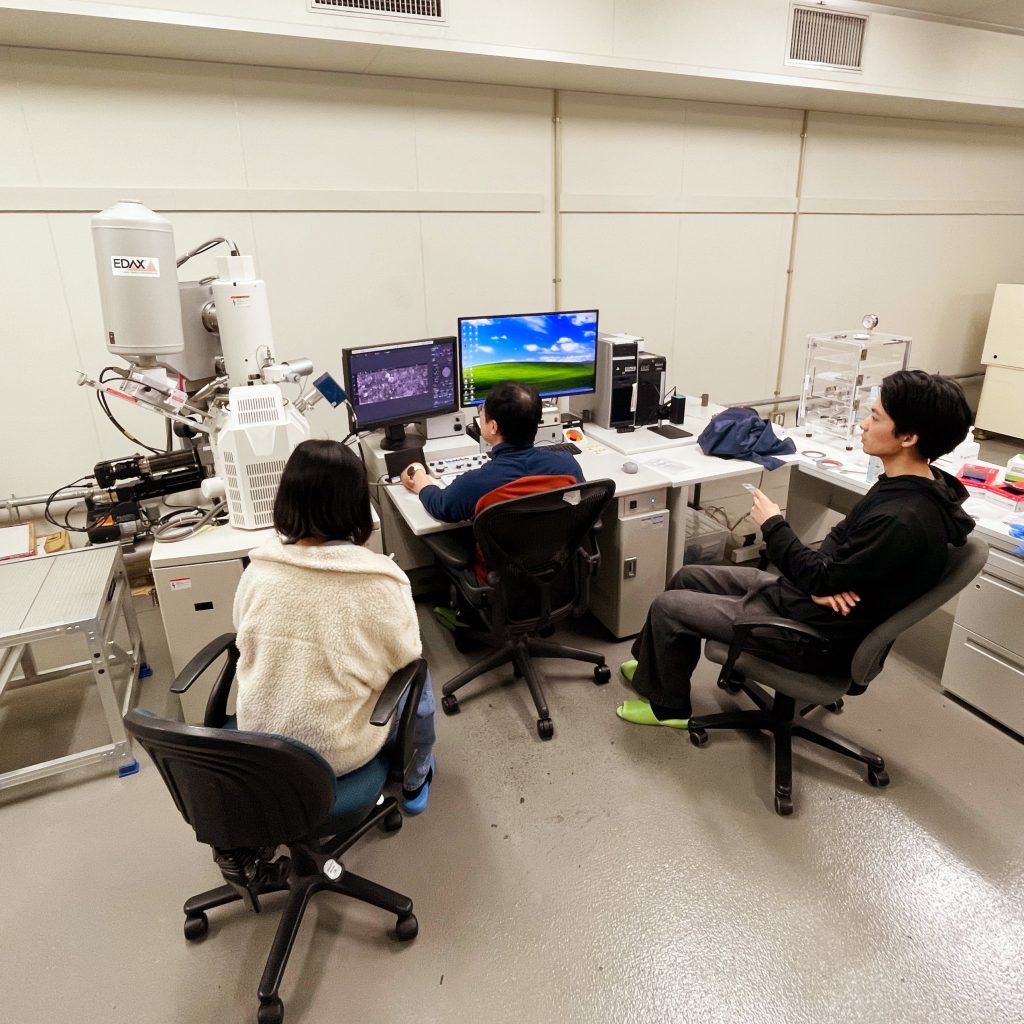
今回は、加熱処理前後の試料についてSEM-EDSによる元素マッピング解析を行いました。特に亜鉛(Zn)および硫黄(S)の分布変化に注目し、「濃縮なのか移動なのか」「他元素との相互作用はあるのか」といった点を議論しました。
観察の結果、亜鉛は処理後に一部へ局在化して見える傾向が確認されました。ただし、単純な増減ではなく、再分配や相変化の可能性も示唆されています。硫黄やイオン種の関与についても、今後の検証が必要です。
高校生インターンが主体となり、研究室学生がTAとして支援する形で解析を進めました。データをもとに仮説を立て、次の実験計画へつなげていく過程そのものが、本プログラムの重要な学習機会となっています。
今後も月1回のペースで研究を継続し、段階的に理解を深めていきます。
QFC-SP Research in Progress: Fundamental Study on Microwave Treatment of Zinc-Containing EAF Dust
The QFC-SP high school research internship project is steadily progressing.
This year’s research theme focuses on fundamental studies of microwave-assisted treatment of zinc-containing electric arc furnace (EAF) dust, aiming at future resource circulation and decarbonization in steelmaking. Our current priority is to understand the underlying phenomena step by step.
In this session, we conducted SEM-EDS elemental mapping to compare samples before and after thermal treatment. Particular attention was paid to the distribution of zinc (Zn) and sulfur (S), discussing whether the observed localization is due to concentration, migration, or interactions with other elements.
Preliminary observations suggest that zinc appears more localized after treatment. However, this may reflect redistribution or phase transformation rather than a simple increase or decrease in amount. The possible involvement of sulfur and ionic species will require further investigation.
The high school intern led the discussion and data interpretation, supported by graduate student TAs from the laboratory. Formulating hypotheses based on real experimental data and designing the next steps is an essential part of this long-term research-oriented program.
The project will continue on a monthly basis, gradually building a deeper understanding of the system.
