![反応制御学研究室[大野研究室 / Ohno LAB.]](https://www.ironmaking.kyushu-u.ac.jp/wp/wp-content/uploads/2025/04/スクリーンショット-2025-04-07-16.54.15.png)
九州大学 工学部では、「II群(化学系)」に所属する2年生が、秋学期に学科配属を決定します。
その進路選択の大きなきっかけとなるのが、「工学概論」という講義です。
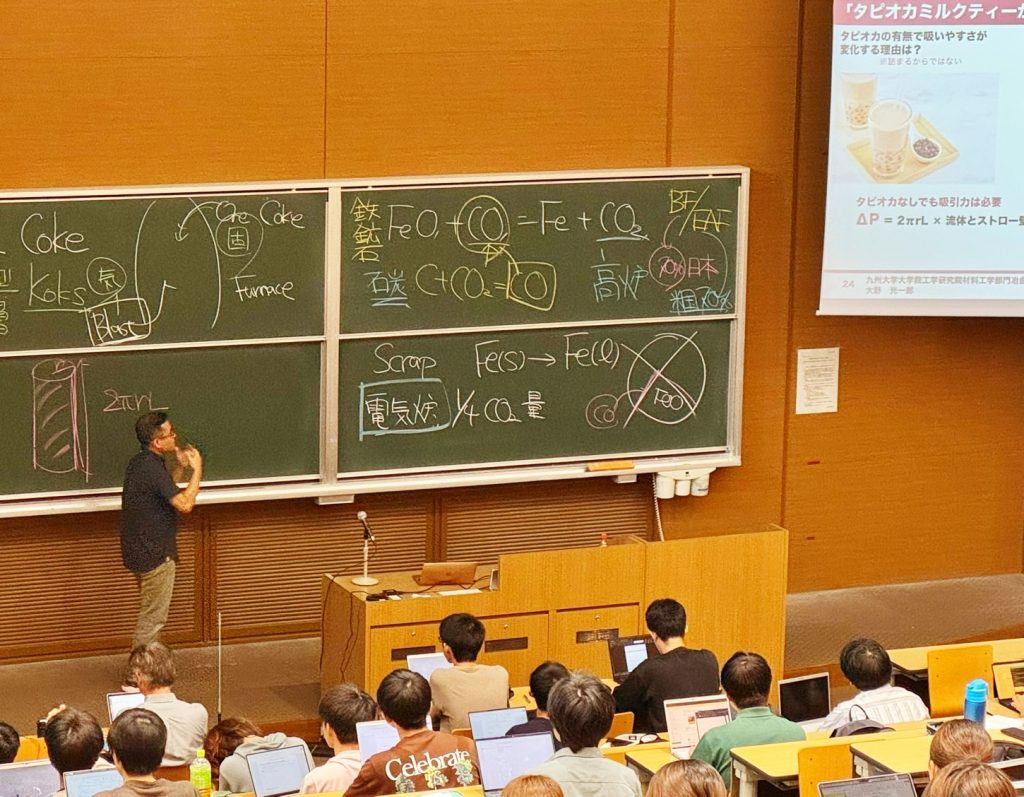
今回の講義で、私はこんな問いかけから話を始めました。
「なんでタピオカミルクティーって、たまに吸いにくいんだろう?」
身近な疑問を入口に、
「圧力損失」「粒子層の抵抗」といった基礎概念を説明し、
そこから「高炉内の通気性」「製鉄プロセス」へと話を広げ、
最終的には「鉄鋼業のCO₂排出」「水素還元製鉄」
そして日本が進める GX(グリーントランスフォーメーション) にまで展開しました。
講義中は、予想以上に多くの学生が顔を上げて反応してくれ、
アンケートでも印象的なコメントが多く見られました。
-
「トランプ、鬼滅、タピオカ、GXが全部出てきたのがすごい(笑)」
-
「講義があっという間でした!」
材料工学は、ときに「地味」「難しそう」と思われがちですが、
本質的には “化学を社会でどう使うか”を考える学問 です。
特に製鉄分野では、わずかな技術革新が、
世界規模でのCO₂削減や社会変革につながります。
君が学んできた化学は、社会を動かす力になる。
その舞台の一つが、材料工学であり、製鉄です。
この秋、新しい仲間を迎えられることを楽しみにしています。
材料で世界を変えたい人、
脱炭素という大きな課題に挑みたい人と、
一緒に未来をつくっていければと思います。
Can Decarbonized Ironmaking Be Explained with Bubble Tea?
— An Attempt to Communicate the Appeal of Materials Engineering to Students
At Kyushu University, second-year students in the “Group II (Chemistry-related)” track choose their department in the autumn semester.
One of the most important opportunities influencing this decision is a lecture course titled Introduction to Engineering.
In my lecture, I started with a simple and familiar question:
“Why is bubble tea sometimes so hard to drink through the straw?”
Using this everyday experience as a starting point, I introduced fundamental concepts such as pressure loss and flow resistance in packed beds.
From there, the discussion naturally expanded to gas permeability in blast furnaces and ironmaking processes, eventually leading to broader topics such as CO₂ emissions from the steel industry, hydrogen-based ironmaking, and Japan’s Green Transformation (GX) initiative.
During the lecture, far more students than expected were actively engaged, and the post-lecture survey included comments such as:
-
“It was amazing how playing cards, anime, bubble tea, and GX all appeared in one lecture!”
-
“The lecture felt incredibly short — I was completely absorbed.”
Materials engineering is sometimes misunderstood as being abstract or difficult, but at its core, it is a discipline about how chemistry can be applied to society.
Ironmaking, in particular, is a field where even small technological innovations can lead to global-scale impact, including significant reductions in CO₂ emissions.
The chemistry you have learned has the power to change society.
Materials engineering — and ironmaking — is one place where that power can be realized.
We look forward to welcoming new students this autumn,
especially those who want to change the world through materials
and take on the challenge of decarbonizing steelmaking together with us.
